
When you think of a car, you probably picture the engine, wheels, or battery. But hidden inside every vehicle are hundreds of springs. They absorb shocks, return pedals, clamp brakes, and keep seats comfortable.
Without springs, a car simply wouldn't work.
And without spring machines, those springs couldn't be made – at least not with the speed, precision, and consistency the automotive industry demands.
In this article, we'll show you how spring machines power the automotive industry – and why choosing the right spring coiling equipment matters more than ever.
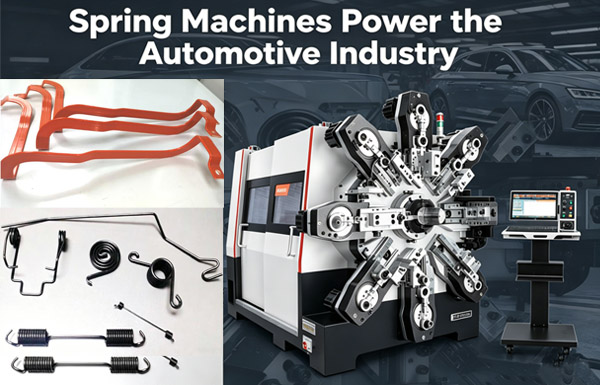
Why Automotive Springs Are Different
Not all springs are created equal. A spring in a ballpoint pen is very different from a spring in an engine valve. Automotive springs face extreme conditions:
● Constant vibration
● Heavy loads (up to thousands of kilograms)
● Wide temperature ranges (-40°C to 150°C)
● Millions of compression cycles
That means automotive springs must be made with tight tolerances, high-strength materials, and perfect consistency. Even a tiny defect can cause failure on the road.
Spring machines designed for general manufacturing often can’t meet these demands. That’s why automotive suppliers turn to high-performance spring forming machine.
Key Automotive Applications Powered by Spring Machines
Here are the most common places where springs – made by spring machines – keep vehicles running safely and smoothly.
| Automotive System | Spring Type | What It Does |
| Suspension | Heavy coil springs | Absorbs road shocks, supports vehicle weight |
| Engine valves | Precision compression springs | Closes valves after each combustion cycle |
| Brakes | Return springs | Pulls brake pads away from rotors after release |
| Clutch | Diaphragm spring | Engages and disengages engine power |
| Seats | Tension & torsion springs | Adjusts position, provides comfort |
| Seat belts | Spiral spring (clock spring) | Retracts belt automatically |
| Fuel injectors | Micro compression springs | Controls fuel spray patterns |
| Trunk & hood latches | Extension springs | Keeps lids closed or pops them open |
What Makes a Spring Machine "Automotive?Ready" ?
Not every spring machine can handle automotive production. Here are the features that matter most:
1. Wide Wire Diameter Range
Automotive springs use wire from 0.2 mm (for fuel injectors) up to 16 mm (for truck suspension). A good spring machine covers this full range – or is available in dedicated models for micro or heavy wire.
2. High Precision (±0.05 mm or better)
Valve springs, for example, require near?perfect concentricity and pitch consistency. A servo?controlled CNC spring machine delivers repeatable accuracy that cam?driven machines cannot match.
3. High Speed & Long?Run Reliability
Automotive orders often run into millions of pieces. The spring machine must run 24/7 with minimal drift. Features like forced lubrication, rigid construction, and thermal stability are essential.
4. Quick Changeover
A single automotive supplier may produce dozens of different spring types every week. Tooling changeover time directly affects profitability. Modern camless spring machines can switch jobs in 15 minutes or less.
5. Material Handling for High?Strength Alloys
Automotive springs use chrome silicon, chrome vanadium, and other tough alloys. The spring machine needs powerful feed rollers and straighteners to handle these materials without scratching or bending.
Real?World Results: How the Right Spring Machine Changes Production
Let's look at an example.
An automotive suspension spring supplier was using old cam?driven coilers. Changeover took 90 minutes. Scrap rate was over 3%. They switched to a modern 12?axis CNC spring machine with servo drives and quick?change tooling.
The results after six months:
? Changeover time: 90 minutes → 15 minutes
? Scrap rate: 3.2% → 0.7%
? Output per shift: +28%
? Return on investment: less than 10 months
This is not magic. This is what a properly engineered spring machine can do for automotive manufacturing.
The Future: Spring Machines for Electric Vehicles (EVs)
The rise of electric vehicles is changing spring requirements. EVs are heavier (due to batteries) but have fewer moving parts. New spring applications include:
● Battery module connecting wires (flexible busbars) – formed on wire bending machines
● Cooling system springs – tiny precision springs for thermal management valves
● Charging port springs – for reliable electrical contact
Spring machine manufacturers are already developing specialized tooling and software to meet these EV?specific demands. If you supply springs to EV makers, your equipment strategy needs to evolve too.
Why Choose the Right Spring Machine Manufacturer?
You can buy a spring machine from anywhere. But automotive?grade production requires a partner who understands:
● High?strength spring steels
● ISO/TS 16949 quality standards
● Just?in?time delivery pressures
● Global service and spare parts support
At VINSTON, we design and manufacutre spring machines specifically for demanding industries like automotive. Our machines are:
● CNC servo?controlled – for infinite flexibility and precision
● Rigid and durable – built for 24/7 operation
● Easy to program – with user?friendly software
● Backed by global support – training, spare parts, remote diagnostics